Yes, many bay windows can be cleaned with a water-fed pole, but their shape matters. A projecting ground-floor bay may be straightforward, while an upper bay set back above a roof, canopy or deep sill can demand a different working position. The deciding question is not simply the height: it is whether the cleaner can control the brush, see the glass and rinse each pane safely from the ground.
If you want to clean bay windows with a water-fed pole at a Telford home, a clear photo and a short access description can often reveal more than the words “two-storey house”. This guide explains what affects reach, how the Pure-Water method works around angled panes, what homeowners can prepare, and when an awkward bay needs closer assessment.
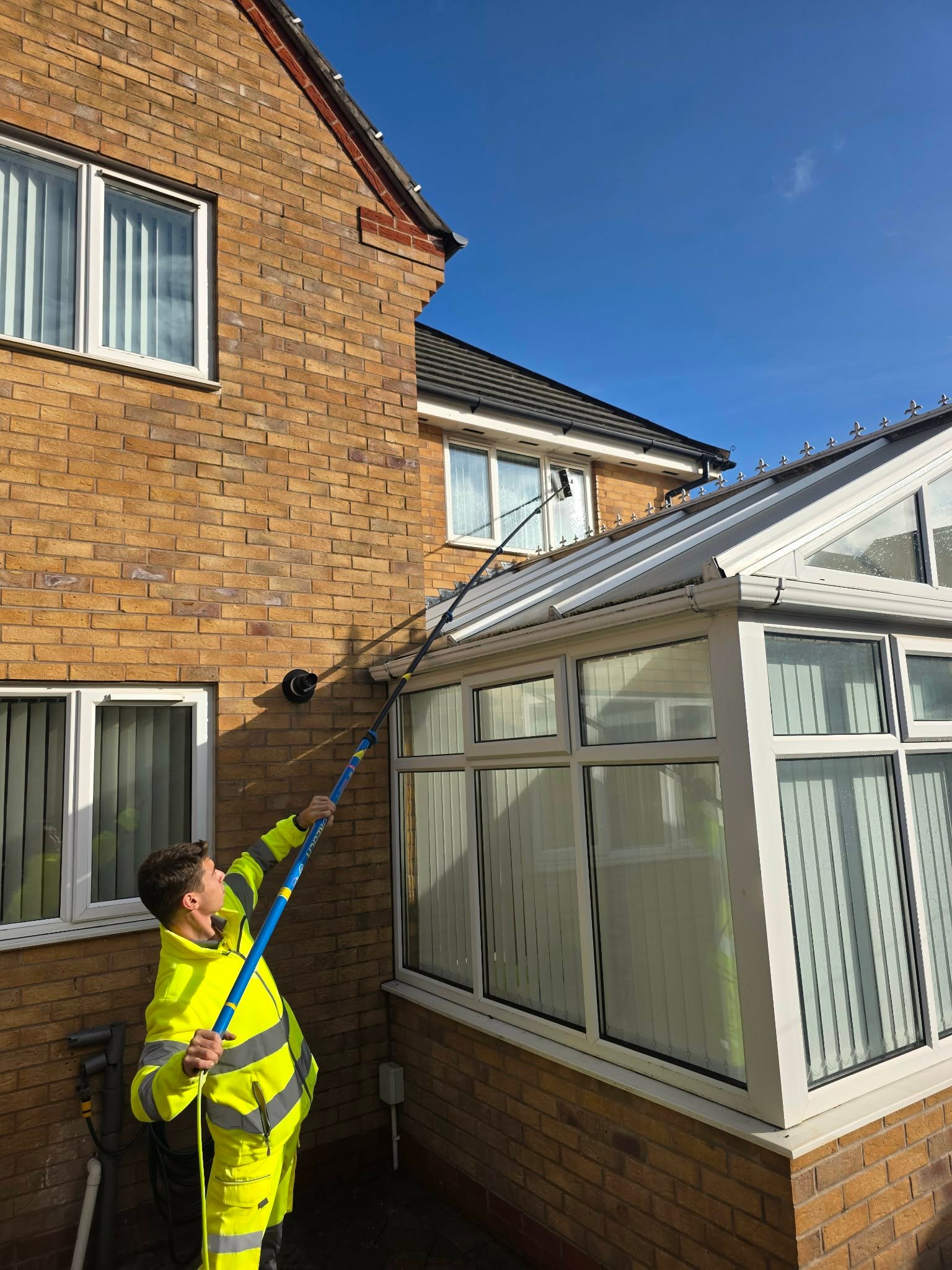
Can you clean bay windows with a water-fed pole?
In many cases, yes. The brush can be guided across the outside glass while purified water loosens and carries away ordinary dirt. The pane is then rinsed and normally left to dry naturally. You can read the wider explanation in how Pure-Water window cleaning works.
Bay windows need more thought than a flat wall of glass because they project beyond the main elevation. Their side panes sit at an angle, the central pane may be wider, and an upper bay may stand above a sloping bay roof. Those features change the pole angle and the distance between the cleaner and the glass.
A water-fed pole is useful because it allows many exterior panes to be cleaned from ground level. It does not make every position automatically reachable, however. The cleaner still needs a firm place to stand, enough room to move the pole, a safe route for the hose, and a clear view of the brush on the glass.
What makes one bay window easier than another?
| Bay-window feature | Why it matters | What to mention before booking |
|---|---|---|
| Ground-floor bay | Usually offers a shorter, more direct pole angle, provided planting and furniture do not block the approach. | Deep beds, thorny shrubs, pots or a narrow path in front of the glass. |
| Upper bay | The lower bay or its roof can push the cleaner farther away from the upper panes. | Send a full-height photo showing the ground and both levels. |
| Deep sill or projecting canopy | The brush may need to work at a shallower angle, and the outer edge can obstruct the lower part of the glass. | Show the side profile rather than only a front-on photograph. |
| Angled or curved arrangement | Each pane needs controlled brush contact and a separate rinse path. | Say whether the bay has flat facets, narrow side panes or a curved appearance. |
| Decorative or leaded glass | Raised details, ageing leading or delicate finishes deserve advance notice and a condition-aware approach. | Share a close photo and read the guide to water-fed poles and leaded windows. |
| Restricted frontage | Parked cars, walls, railings and public footways can reduce the safe working area or affect the hose route. | Explain where the cleaner can stand and whether the frontage is shared. |
How a bay window is assessed before cleaning
1. Start with the complete elevation
A close-up of the glass shows dirt, but it does not show access. A useful assessment photo includes the ground, the full bay, any upper windows, the roofline and the space immediately in front. For an upper bay, a second photograph from an angle can show how far the lower bay projects.
2. Check the ground position and pole path
The cleaner needs a stable position from which the pole can be moved without striking walls, gutters, overhead obstructions or nearby property. Standing immediately beneath a projecting bay is not always the best position; moving farther back can improve the pole angle, but only if the frontage provides enough space.
That is why a modest bay beside a wide drive may be simpler than a lower bay behind railings on a very narrow path. Access, not just glass area, shapes the method.
3. Consider the roof, sill and window geometry
A sloping bay roof may separate the cleaner from the upper glass. A deep sill can also hide the bottom edge of a pane from a poor working angle. The aim is controlled contact rather than stretching the pole to its theoretical limit. If the brush cannot sit correctly against the surface, forcing the angle is not a sound solution.
4. Identify delicate or damaged areas
Tell the cleaner about cracked glass, loose seals, fragile leading, peeling finishes, window film or any previous leak. Exterior cleaning cannot repair a failed seal or defect, and advance information allows the condition to be considered before water reaches the window.
5. Agree what is actually being cleaned
A bay contains several elements: glass, frames, sills, a roof or canopy, decorative panels and sometimes nearby guttering. This service is residential exterior glass-focused window cleaning. Do not assume that the bay roof, guttering or another surface is included merely because it is close to the windows. The guide to what is included in an exterior window clean helps you ask the right question before agreeing the visit.
How Pure-Water cleaning works on angled bay panes
The cleaner brings purified water prepared for the system; your household tap is not used to supply the clean. Water travels through the pole to the brush head. The brush action loosens ordinary dirt from the exterior glass, and a controlled rinse carries it away.
On a bay, the central and side panes are treated as separate surfaces. The pole angle changes as the brush moves around the projection. Good results depend on reaching the pane with appropriate brush contact, working the edges carefully and rinsing each section rather than simply spraying water from a distance.
After rinsing, the glass is normally left wet so the purified water can dry naturally. Do not wipe the outside with a cloth after the visit: a cloth can reintroduce minerals or residue. Drying time varies with temperature, airflow, shade and the shape of the window, so it is better to assess the result after the glass has dried. The article why windows are left wet after cleaning explains this in more detail.
Why upper bay windows can be more awkward
An upper bay may look no higher than the bedroom windows beside it, yet its projection can make it more demanding. The lower bay, tiled roof or canopy creates horizontal distance. As the cleaner steps back to clear that projection, the pole becomes more angled and requires room behind the working position.
The cleaner also needs to see the brush head. Trees, porch roofs and the shape of the bay can interrupt that sightline. Safe cleaning therefore depends on the whole arrangement:
- how far the bay projects from the wall;
- the depth and pitch of the roof or canopy below;
- the height and width of the target panes;
- the space available on the drive, path or garden;
- parked vehicles, railings and planted areas;
- the ability to control the hose without creating avoidable trip risks.
This is similar to the access question for windows above a conservatory or extension, although a bay is usually a smaller projection. Neither case should be judged from height alone.
When a water-fed pole may not be suitable
There is no responsible universal promise that every bay window can be reached. A water-fed pole may be unsuitable when the only available position is unstable, the pole cannot be controlled around the projection, obstructions prevent proper brush contact, or the cleaner cannot see the working area sufficiently.
Unsafe ice, severe wind or another genuine site hazard can also change the decision on the day. Cold weather alone does not normally stop work because heated purified water and a heated water-fed-pole system are used in winter, but safe footing and control still come first.
Homeowners should not climb onto the bay roof, lean from an upstairs window or improvise a platform to make access easier. Moving a light plant pot is useful; creating a risky access arrangement is not. If the photographs suggest a doubtful position, it is better to discuss it before the booking than discover the limitation after arrival.
How to prepare a bay window for cleaning
Preparation should be proportionate. You do not need to dismantle the area or wash the glass yourself. Concentrate on access and anything that could be damaged or create an obstruction.
- Close the bay windows securely. Check opening sections and suitable vents so water cannot enter through a known gap.
- Move only easy obstructions. Relocate light pots, small ornaments and portable garden furniture if they block the approach. There is no need to move heavy fixed items without discussion.
- Keep the working route clear. Children and pets should stay away from the pole, brush and hose while work is taking place.
- Move a vehicle if it restricts the pole angle. A car close to the bay can remove the safest standing position. See whether to move your car before window cleaning.
- Arrange gates and shared access. Mention locked gates, neighbour-controlled passages or a frontage shared with another property.
- Point out faults or delicate finishes. Cracks, failed seals, window film, loose leading and recent building residue should be disclosed before cleaning.
For the wider visit, use the practical pre-window-cleaning checklist.
What not to do before the visit
- Do not pre-wash the outside glass. It is unnecessary and can make the condition harder to assess.
- Do not apply household sprays or polish. Residue can change how water behaves on the pane.
- Do not cut back established plants without first checking. A photograph may show that the pole can work around them.
- Do not move heavy stone pots or fixed furniture alone. Describe the obstruction and agree what is practical.
- Do not promise access through a neighbour’s land. Confirm any shared or third-party access before the appointment.
- Do not expect exterior cleaning to remove marks between panes. Moisture or staining inside a sealed unit is not on the exterior surface. The guide to locating window marks can help.
First clean versus regular maintenance
A bay that has not been professionally cleaned for some time may need more careful brushing and rinsing than a maintained window. Dirt can collect at lower edges, in corners and around projecting frames. A first visit is therefore not necessarily identical to later maintenance visits.
There is no automatic first-clean surcharge, but the property still needs to be assessed accurately. Recent paint, silicone, cement splashes or other bonded contamination should be mentioned because exterior glass cleaning is not the same as specialist removal of building residue. For a fuller explanation, see what happens on a first window clean in Telford.
For ongoing care, regular six-weekly cleaning is available, as is one-off cleaning. The better choice depends on whether you want continuing maintenance or a single visit for a particular reason. A regular schedule can prevent ordinary environmental dirt from building up heavily around the bay’s angles and lower edges.
Questions to ask when booking bay-window cleaning
- Can you assess the upper bay from photographs before confirming access?
- Should the drive or frontage be clear for the pole position?
- Does the agreed exterior clean cover all bay-window panes?
- Are the bay roof, canopy or nearby surfaces outside the agreed service?
- Do you need anyone at home if the frontage and any gates are accessible?
- Should I report cracked glass, loose leading or window film in advance?
- Would a one-off visit or regular six-weekly cleaning suit my needs?
- What price and payment arrangement applies to this property?
The minimum call-out is £19, with no automatic first-clean surcharge. The final arrangement should reflect the property and agreed work rather than an assumption based only on the number of rooms. You can review the current pricing information and describe the bay when making contact.
Quick photo checklist for an accurate enquiry
Before contacting a window cleaner about an awkward bay, take:
- one straight-on photograph showing the entire bay and the ground below;
- one side-angle photograph showing the depth of the projection;
- one wider photograph showing the drive, path, railings, parked cars and nearby planting;
- a close-up only if there is cracked glass, decorative leading, film or bonded residue.
Add a short note stating whether the bay is at ground-floor or upper-floor level, whether access is shared, and whether vehicles can be moved. This gives a much more useful picture than a close-up of the dirty pane alone.
Frequently asked questions
Can a water-fed pole reach the side panes of a bay window?
Often, yes. The cleaner changes position and brush angle for each facet. Suitability depends on having enough space to control the pole and make proper contact with the side pane.
Can you clean an upstairs bay above a ground-floor bay?
Many can be cleaned, but the lower projection and bay roof affect the approach. A full-height and side-on photograph is the most useful starting point for an access assessment.
Will someone stand on the bay roof?
A ground-based water-fed-pole method is preferred where it is safe and suitable. Homeowners should not prepare access by standing on, or placing improvised equipment on, a bay roof.
Does the bay roof get cleaned at the same time?
Do not assume so. This service is exterior glass-focused window cleaning, and the roof or canopy is a separate surface. Confirm the exact inclusions before booking.
Do I need to provide water?
No. Purified water is prepared and brought to the property for the water-fed-pole system; the customer’s tap and household water are not used for the clean.
Why is the bay window left wet?
The purified-water rinse is normally allowed to dry naturally. Avoid wiping the exterior. Drying time varies, so inspect the finished pane after it has dried rather than while rinse water is still visible.
Can a bay with leaded glass be cleaned?
Potentially, but the condition of the leading and glass should be considered. Send a close photograph and disclose anything loose, ageing or already damaged before the visit.
Do I need to be at home?
That depends on access. If the bay is at the front and no locked gate or indoor access is involved, attendance may not be necessary, but confirm the arrangement when booking rather than assuming.
What if a parked car blocks the safest position?
Arrange to move it before the visit if requested. The cleaner needs enough clearance for the pole and a sensible hose route, and water should not be directed onto a nearby vehicle.
Book exterior bay-window cleaning in Telford
A bay window is best quoted from the real layout, not a generic house type. If you are unsure whether an upper bay, deep sill, narrow frontage or decorative pane is suitable, send clear photographs and explain the access. That allows the cleaner to consider the glass and the working area together.
For residential window cleaning in Telford, one-off and regular six-weekly exterior cleaning are available. The minimum call-out is £19 and there is no automatic first-clean surcharge. To ask about your bay window, use the contact page or telephone with a brief description of the property.