Upstairs windows can often be cleaned from the ground with a water-fed pole. Purified water travels through the pole to a brush, allowing the cleaner to scrub and rinse exterior glass without needing to stand beside the window. The method is practical for many two-storey homes, but reach is not decided by height alone. The cleaner also needs a stable working position, a controllable pole angle, a clear view of the glass and a safe route for the hose.
If you are wondering how upstairs windows are cleaned from the ground at a Telford home, look at the whole elevation rather than only the upper pane. A conservatory, extension, porch, deep sill, narrow side passage or parked car can make a lower window more awkward than a higher one on an open wall. This guide explains how the method works, what affects access and what to tell the cleaner before booking.
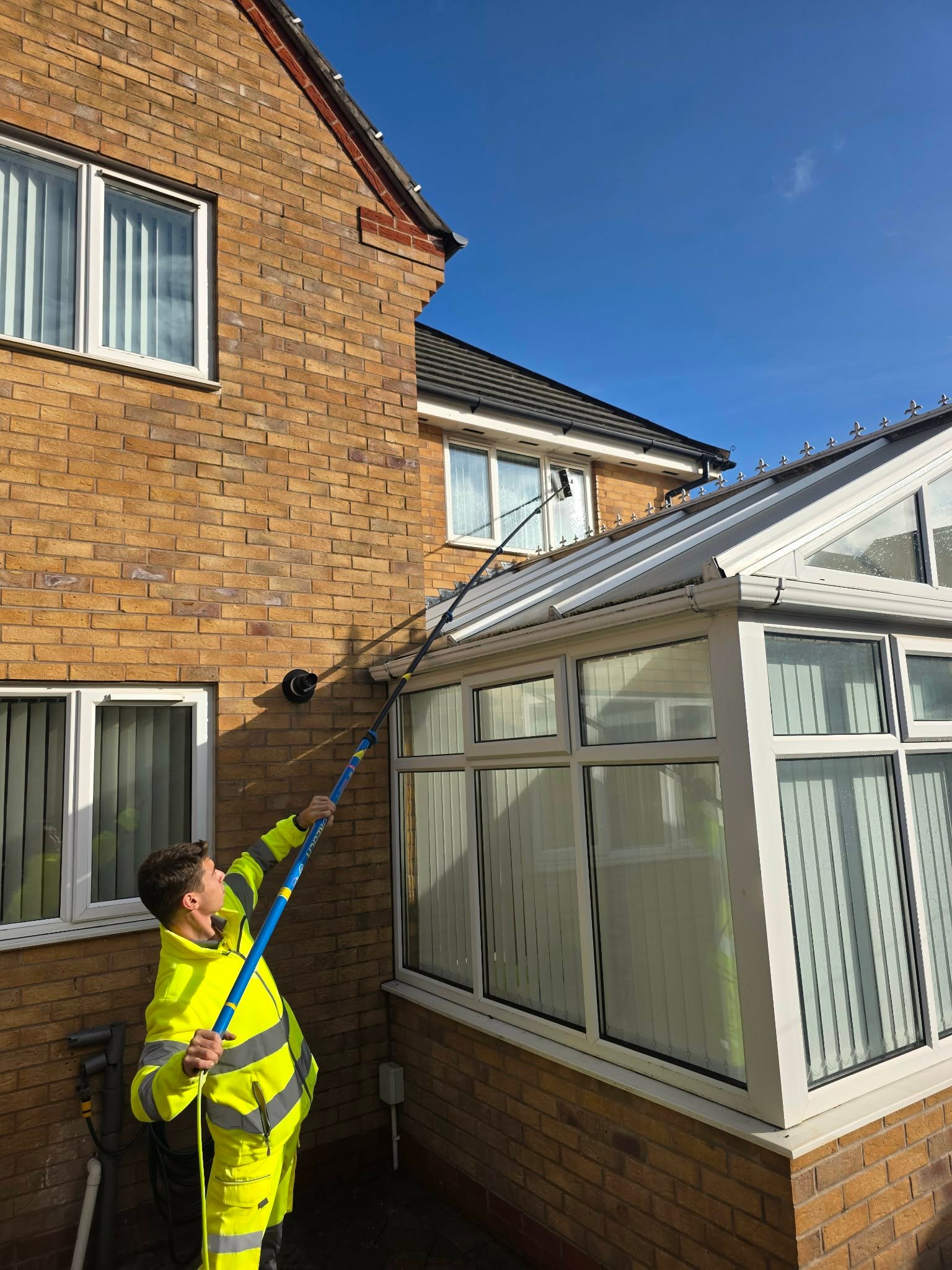
How are upstairs windows cleaned from the ground?
The usual process uses a telescopic water-fed pole with a brush at the top. The cleaner brings purified water prepared for the system; the customer’s household supply or garden tap is not used for the clean. Water is delivered through the pole to the brush head while the cleaner works from ground level.
A typical upstairs pane is cleaned in four practical stages:
- Positioning: the cleaner chooses firm ground with enough room to extend and control the pole.
- Agitation: the brush is guided across the glass to loosen ordinary dirt, paying attention to edges and corners.
- Rinsing: purified water carries loosened dirt away from the pane.
- Natural drying: the exterior glass is normally left wet so the low-mineral water can dry without being wiped.
The result depends on technique as much as equipment. Flow, brush contact, agitation and a thorough rinse all matter. The detailed guide to how Pure-Water window cleaning works explains why the glass is treated this way.
Why the ground position matters as much as height
A pole may be long enough to reach a window in a simple height calculation, yet still be unsuitable from the available position. As a pole extends, the angle, surrounding obstacles and the cleaner’s view become increasingly important. A professional assessment therefore starts at ground level.
Stable footing
The cleaner needs firm, reasonably level ground. Loose objects, steep changes in level, dangerous ice and clutter can reduce control. The working position should not depend on a customer creating an improvised platform or standing on garden furniture.
Room for the pole angle
A water-fed pole is not normally held straight against the wall. The cleaner needs space to stand back and create an angle that lets the brush sit correctly against the pane. A vehicle, boundary wall or very narrow path can remove that space even when the window itself is not unusually high.
A clear sightline
The brush needs to be guided around the pane, not waved towards a window that cannot be seen. Overhanging roofs, dense plants and deep projections may hide part of the glass. A clear sightline helps the cleaner maintain contact and rinse the full surface.
A sensible hose route
The hose must reach the working area without creating an avoidable hazard around entrances, shared paths, children or pets. Locked gates and rear access should be discussed before the appointment, especially if nobody will be at home.
Common upstairs-window layouts
| Window layout | What usually affects access | Useful information to send |
|---|---|---|
| First-floor window on a flat wall | Ground condition, room to stand back and nearby vehicles or planting. | A wide photograph showing the window and the ground below. |
| Window above a porch | Porch depth, roof pitch, guttering and whether there is space to change the pole angle. | A front and side photograph showing the full porch. |
| Window above a conservatory or extension | The projection can move the cleaner farther from the glass and interrupt the sightline. | Show the complete extension and the available working area; read the guide to windows above conservatories and extensions. |
| Upper bay window | The lower bay, roof and deep sills change the horizontal distance and brush angle. | Use the specific guide to cleaning bay windows with a water-fed pole. |
| Window in a narrow side passage | Walls, bins, gates and limited space may prevent the pole from being set at a useful angle. | Measure or photograph the passage and mention whether items can be moved. |
| Roof window or skylight | Pitch, visibility and surrounding roofline differ from a vertical first-floor pane. | See the separate assessment guide for roof windows and skylights. |
Can every upstairs window be cleaned this way?
No single access method suits every window. A water-fed pole is preferred where it can be used safely and effectively from the ground, but it does not make every pane automatically reachable. Suitability depends on the complete property layout, the condition of the window and the conditions on the day.
A pane may need closer assessment when:
- a deep conservatory, extension or porch sits directly below it;
- there is too little space to create a controllable pole angle;
- the only working position is unstable or obstructed;
- the window cannot be seen properly from the available ground area;
- overhead cables or other obstructions affect the pole path;
- the glass, frame, leading or seals are visibly damaged;
- severe wind, dangerous ice or another site hazard would make control unsafe.
Cold weather alone does not normally stop work. In winter, heated purified water is used and the whole water-fed-pole system is heated. That does not override genuine safety issues: slippery access, unsafe ice or severe wind can still require postponement.
What the brush actually does at upstairs level
From the ground, the cleaner controls the pole so the brush makes contact with the exterior surface. Water alone is not the whole process. The brush action loosens everyday grime, while the water flow helps carry contamination away. The pane then receives a controlled rinse.
The cleaner changes the pole length and angle rather than treating every upstairs window identically. Narrow opening sections, wider fixed panes, frames and lower edges can require different movements. On a first clean, built-up ordinary dirt may demand more work than on a maintained six-weekly visit.
Some marks are not on the exterior surface at all. A smear inside the room or moisture between sealed panes cannot be removed by exterior cleaning. Before booking for a particular mark, the guide to identifying whether a window mark is inside, outside or between the panes can save confusion.
Why purified water is brought to the property
The window cleaner prepares the purified water and carries it to the job as part of the system. The customer’s tap, garden hose and household water supply are not needed for the clean. Removing most dissolved minerals helps avoid the residue that ordinary tap water can leave as droplets evaporate.
This does not mean every wet pane will look finished immediately. The exterior is normally left to dry naturally, and drying time changes with temperature, shade, airflow and the shape of the window. Do not wipe the outside after the visit, because a household cloth can reintroduce minerals or residue. Read why windows are left wet after Pure-Water cleaning for more detail.
Upstairs access problems homeowners often overlook
Cars parked close to the house
A car may occupy the best working position or prevent the cleaner from stepping back far enough. It can also complicate the hose route. If requested, move it before the visit and keep enough clearance between the vehicle and the working area. The practical guide on moving a car before window cleaning explains why this matters.
Open windows and vents
Exterior water can enter through an open upstairs window or an unsuitable vent. Close windows securely before the clean and tell the cleaner about damaged seals, existing leaks or frames that do not close properly. The article on water coming inside during exterior cleaning covers the main causes.
Locked gates
An upstairs rear window may be physically reachable, but not if the cleaner cannot enter the back garden. Agree how access will be provided, especially when nobody will be home. Never assume that a shared or neighbour-controlled gate will be available.
Plants and garden furniture
Small pots, chairs and lightweight ornaments can block the best pole position. Move only items that are easy and safe to relocate. There is no need to drag heavy planters or dismantle a garden before the cleaner has seen the layout.
Delicate glass and finishes
Point out cracks, loose decorative leading, peeling coatings, window film, damaged seals or recent building work. A water-fed pole is a cleaning tool, not a repair method, and bonded contamination may fall outside an ordinary exterior clean. For decorative panes, see the guide to water-fed-pole cleaning for leaded windows.
How to prepare for upstairs window cleaning
Most homes need only a few sensible preparations:
- Close all upstairs windows and check any opening sections or suitable vents.
- Arrange access through side or rear gates before the cleaner arrives.
- Clear the working position by moving light pots, bins or furniture only where necessary.
- Move vehicles if requested so the pole can be controlled from the best position.
- Keep children and pets away from the pole, hose and active working area.
- Report defects and delicate finishes before water reaches the window.
- Send useful photographs if a porch, extension, roof or narrow passage makes access uncertain.
You do not need to wash the glass first, provide water, buy equipment or stay outside during the work. The fuller pre-visit window-cleaning checklist covers the rest of the property.
What photographs help with an upstairs-window enquiry?
A close-up of the dirty pane is rarely enough. For a useful access assessment, send:
- one wide photograph showing the full wall from ground to roofline;
- one side angle if a porch, bay, canopy or extension projects from the building;
- a photograph of any narrow passage or locked access route;
- a wider view showing cars, railings, planting and the possible standing area;
- a close-up only when you need to show damage, decorative glass or unusual contamination.
State whether the window is at the front, side or rear; whether the gate is locked; and whether a vehicle can be moved. These details are more useful than describing the home simply as “two storeys”.
Questions to ask before booking
- Can the upstairs panes be assessed from my photographs?
- Which exterior glass is included in the agreed clean?
- Does a porch, conservatory or extension change the access?
- Should any vehicle or garden item be moved?
- Does someone need to be home, or is exterior access enough?
- Should I report window film, cracks, loose leading or failed seals?
- Would a one-off clean or regular six-weekly service suit the property?
- What price and payment arrangement applies to the agreed work?
The service is residential and focused on exterior glass. Confirm the exact scope rather than assuming that nearby roofs, guttering or other surfaces are included. The guide to what is included in an exterior window clean is a useful starting point.
Frequently asked questions
Do window cleaners need a ladder for upstairs windows?
Often they do not. A water-fed pole allows many first-floor exterior windows to be cleaned from the ground. The correct method still depends on access, window position and site conditions; no single method is suitable everywhere.
Can you see whether the upstairs glass is clean from the ground?
The cleaner needs a practical sightline to guide the brush and rinse the pane. The assessment is about visibility and control, not merely whether the pole tip can touch the window.
Can upstairs windows above a porch be reached?
Many can, but the porch depth and roof shape alter the pole angle. Send a side photograph showing how far the porch projects and the space available in front of it.
Will the window be left wet?
Usually, yes. The purified-water rinse is left to dry naturally. Drying time varies, so inspect the pane after it has dried rather than while water is still visible.
Do I need to provide tap water?
No. The cleaner prepares and brings purified water for the water-fed-pole system. The property’s household supply and garden tap are not used for the clean.
Can you clean an upstairs window if I am not at home?
Potentially, if the exterior working area is accessible and all arrangements have been agreed. Locked gates, pets and rear access should be dealt with before the appointment. See whether you need to be home for window cleaning.
What if the glass has not been cleaned for a long time?
A first clean may require more agitation and rinsing than regular maintenance. There is no automatic first-clean surcharge, but the property and agreed work still need an accurate assessment.
Will exterior cleaning remove condensation between the panes?
No. Condensation or staining inside a sealed unit is not on the external glass surface. Exterior cleaning cannot repair a failed sealed unit.
Can upstairs windows be cleaned in winter?
Cold weather alone does not stop normal work because heated purified water and a heated water-fed-pole system are used. Dangerous ice, severe wind or unsafe access can still make postponement necessary.
Book upstairs exterior window cleaning in Telford
If an upstairs window looks awkward, send photographs showing the whole elevation and the ground below it. That allows access, pole angle, visibility and the hose route to be considered together before the visit.
For residential window cleaning in Telford, both regular six-weekly and one-off exterior cleans are available. The minimum call-out is £19, and there is no automatic first-clean surcharge. Review the pricing information, then use the contact page or telephone to describe the upstairs windows and access.