For Window Cleaning Telford, the cleaner prepares and purifies the water before the visit, then brings that purified water to the property. The customer’s household water supply is not used for the clean, and no outside tap is required.
The water is treated to an extremely low level of dissolved minerals so it is suitable for pure-water window cleaning. In practical terms, it is ultra-pure water: the aim is water that is as close as reasonably possible to just H2O, with the dissolved minerals and impurities that can cause spotting removed to a very low level.
This guide explains where that water comes from, how it is purified by the window cleaner, why untreated tap water is not used on the glass, and how the prepared water is delivered through the water-fed-pole system.
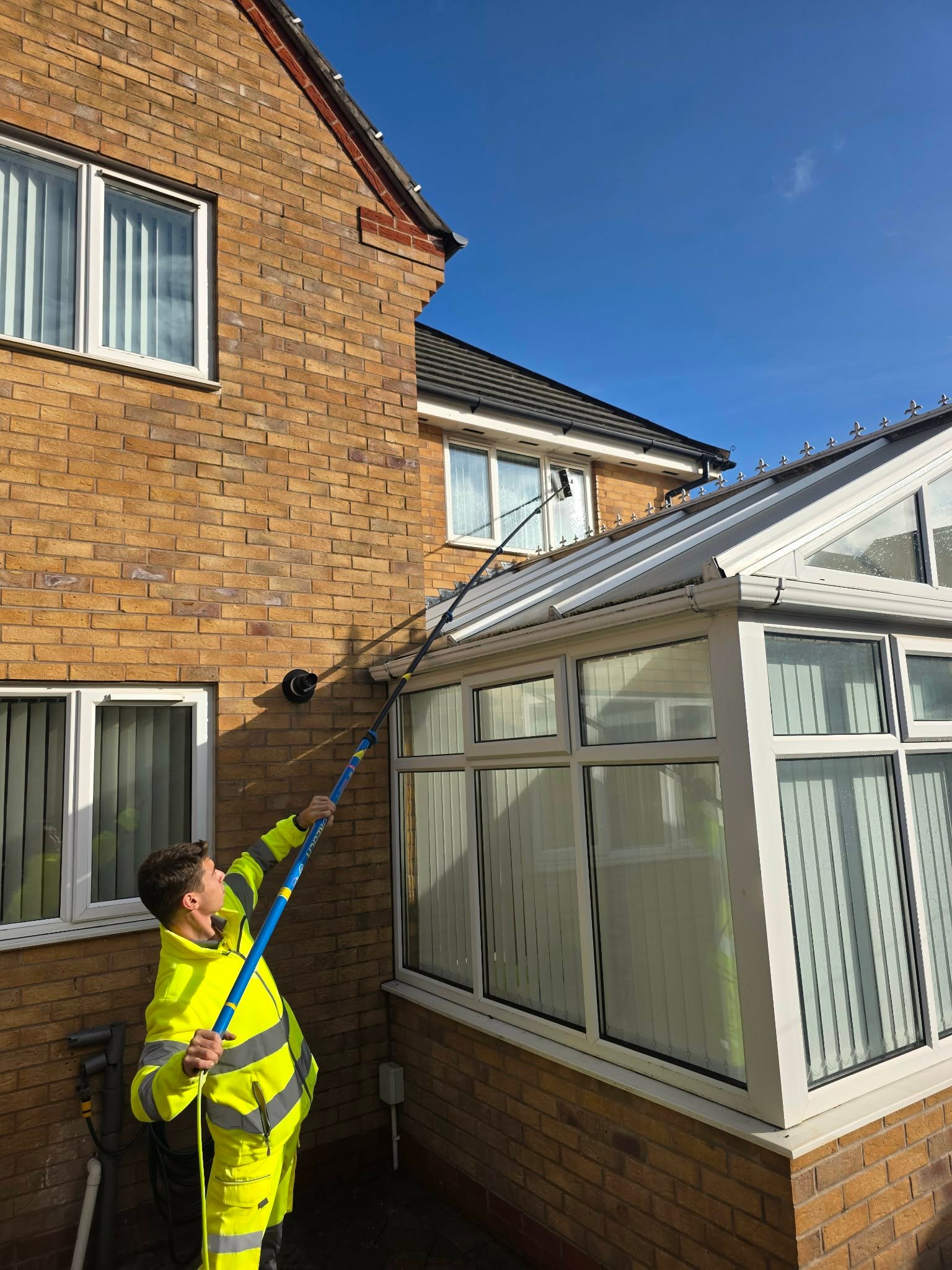
How do window cleaners get water?
For this Telford service, the water goes through three clear stages:
- Source: ordinary mains water is obtained by the window cleaner away from the customer’s property.
- Purification: the window cleaner processes that water through the purification system to remove dissolved minerals and impurities to a very low level.
- Storage and delivery: the prepared pure water is stored, brought to the job, pumped through a hose and sent up the water-fed pole to the brush.
The important point for the homeowner is simple: the water needed for the clean arrives with the window cleaner. The service does not rely on connecting to the house’s outside tap or using the customer’s water supply during the visit.
Why is the water purified?
Mains water naturally contains dissolved substances. The amount varies by area and supply, but calcium, magnesium and other dissolved solids can remain on a surface after ordinary water evaporates. On glass, those residues may appear as spots or marks.
A pure-water system reduces the level of dissolved solids before the water reaches the window. The brush loosens dirt from the exterior glass and the purified water carries the released contamination away during the rinse. The glass is then normally left wet to dry naturally.
That last point can surprise homeowners. The cleaner has not necessarily stopped halfway through. When the glass has been properly scrubbed and rinsed with suitably purified water, there should be no need to wipe every pane by hand.
For a closer look at the cleaning process, read how pure-water window cleaning works. You can also see what TDS means in window cleaning.
How is ordinary water turned into pure water?
There is no single system used by every window cleaner. Professional setups commonly use one or more filtration stages, chosen according to the incoming water quality, the amount required and the way the round is organised.
| Stage or component | What it does | Why it matters |
|---|---|---|
| Pre-filtration | Removes sediment and protects later filtration stages | Helps the main purification equipment work effectively |
| Reverse osmosis | Reduces a large proportion of dissolved material | Useful where the incoming water contains a higher mineral load |
| Deionisation resin | Removes remaining charged dissolved substances | Helps produce very low-TDS water for the final clean and rinse |
| TDS testing | Checks the level of total dissolved solids | Gives the cleaner a practical way to monitor water quality |
Not every setup uses every stage in exactly the same order. What matters to the homeowner is the outcome: the water used on the glass should be suitable for the pure-water method, and the cleaner should use enough brushing and rinsing to remove loosened dirt.
How does the water reach an upstairs window?
After purification, a pump moves the water through a hose. The hose connects to a water-fed pole, and small jets near the brush deliver water directly to the glass.
The brush is not just a way of applying water. It provides the agitation needed to loosen dirt from the pane. The cleaner then rinses the glass so the released contamination can flow away. Water quality alone cannot compensate for rushed brushing or an incomplete rinse.
This ground-based method can make many upper-floor windows accessible without placing a ladder against the property. However, reach is not determined by height alone. Conservatories, extensions, deep sills, narrow passages, parked cars, overhead obstacles and unsafe ground can all affect the practical approach.
See the separate guide on cleaning windows above a conservatory or extension for a more detailed access explanation.
Do we use the customer’s outside tap?
No. Window Cleaning Telford does not use the customer’s household water supply for the normal exterior window-cleaning service.
The water is purified by the window cleaner in advance and brought to the property ready for use. That means you do not need to leave an outside tap accessible and you are not supplying the water used to clean your windows.
The purified water is then pumped from the cleaner’s own system through the hose and up the water-fed pole to the brush. This keeps the water quality under the cleaner’s control from purification through to the final rinse.
You still need to think about practical access around the property — for example locked gates, parked cars, conservatories or narrow side passages — but access to your domestic water supply is not part of the normal visit.
Why parking and hose access matter
Water-fed-pole work involves more than the pole visible at the window. Water still has to move from the system to the brush, so the hose route needs to be considered.
A vehicle parked close to the property may shorten the hose route, but the safest and most practical position depends on the road, driveway, pavement, gates and access around the home. A long hose running through a gate, across a shared path or around parked cars needs active management.
Homeowners can help by mentioning unusual access before the visit, including:
- permit-controlled or restricted parking;
- a shared driveway or communal path;
- a locked side or rear gate;
- a long distance between the road and the house;
- steps, steep paths or loose surfaces;
- cars parked directly beneath the windows;
- pets or young children who may enter the working area.
You do not need to redesign the garden or move every object. Clear only the obstacles that genuinely prevent access, and keep people and pets away from hoses while work is under way. The pre-window-cleaning guide has a complete preparation checklist.
Does a window cleaner carry enough water for every house?
Professional cleaners plan water use around the properties and work expected, but no vehicle tank is unlimited. The amount needed can change with the size and condition of the property, the number of windows, access, and whether it is a first or maintenance clean.
A window that has not been cleaned for a long time may require more agitation and rinsing than a window maintained on a regular schedule. Heavy loose contamination can also increase water use. This does not mean every first clean is the same or that more water automatically produces a better result; technique and correct assessment still matter.
If your home is unusually large, has extensive glazing or has just had building work completed, say so when enquiring. Recent construction residue may be bonded to the surface and is not the same as routine dirt. Disclosing it helps the cleaner assess the request without making unrealistic assumptions.
What happens to the water after the windows are rinsed?
The rinse water runs down the exterior glass and surrounding surfaces. Some may reach the ground near the property, which is another reason to keep doors, windows and suitable vents closed and to keep the working area clear.
Windows cleaned with purified water are normally left wet. Drying time varies with temperature, airflow, shade, humidity and the design of the window. It is sensible to wait until the pane is fully dry before judging the finished appearance.
If marks remain after drying, their cause may be old mineral deposits, contamination from frames or seals, building residue, damaged glass or another issue that routine exterior cleaning cannot automatically remove. Read why spots can remain after window cleaning for examples.
What changes in winter?
Cold weather alone does not automatically stop normal window-cleaning work. For this Telford service, heated purified water is used in winter and the entire water-fed-pole system is heated.
That does not remove every weather risk. Dangerous ice, severe wind, unsafe access or other genuine site hazards can still require postponement. The decision should be based on the actual conditions at the property, not temperature alone.
More detail is available in the guide to exterior window cleaning in cold weather.
Quick homeowner checklist before booking
- You do not need to provide an outside tap or household water supply.
- Describe the property size and any extensive glazing.
- Mention conservatories, extensions and difficult upper windows.
- Explain parking restrictions, shared paths or long access routes.
- Confirm how rear access will be arranged.
- Report recent building work, paint, render or bonded contamination.
- Keep children and pets away from hoses during the visit.
- Close windows and suitable vents before exterior cleaning begins.
- Ask what is included and confirm the price/payment arrangement.
Frequently asked questions
Do you bring your own water?
Yes. For Window Cleaning Telford, the purified water is prepared by the window cleaner and brought to the property. The customer’s household water supply is not used for the normal clean.
Can ordinary tap water be used directly on the windows?
Not for the pure-water cleaning method used here. Ordinary mains water is the starting source, but it is processed through the cleaner’s purification system before it is used on the glass. Untreated tap water can contain dissolved minerals that may remain behind as the water dries.
What does a water tank do?
A vehicle-mounted or static tank stores water until it is pumped through the hose and pole. Tanks, pumps and hose reels are parts of a delivery system; they do not replace the need for correct purification, brushing and rinsing.
Do I need to leave my outside tap accessible?
No. The purified water used for the clean is prepared and supplied by the window cleaner, so your outside tap is not required for the normal service.
Why is the window left wet?
Pure-water glass is normally rinsed and left to dry naturally. The aim is to leave very little dissolved mineral content behind, so hand-drying is not normally part of the method.
Can I be out while the windows are cleaned?
That depends mainly on access and any arrangements agreed in advance. If gates are unlocked and the cleaner does not require anything from inside the property, attendance may not always be necessary—but confirm this for your booking. See whether you need to be home for window cleaning.
Pure-water exterior window cleaning in Telford
Window Cleaning Telford provides residential exterior glass cleaning using a Pure-Water Water-Fed Pole system. The water is purified by the window cleaner before the visit, brought to the property and used from the cleaner’s own system. Your household water supply is not used for the normal clean.
The goal is extremely low-TDS, ultra-pure water with the dissolved minerals that can cause spotting removed to a very low level. That prepared water is then used for brushing and rinsing the exterior glass.
Regular six-weekly and one-off cleaning are available, with a £19 minimum call-out and no automatic first-clean surcharge.
If you want to confirm parking or access arrangements for your property, use the contact page or telephone enquiry option. Mention any locked gates, conservatories, extensions, difficult access or recent building work so the request can be assessed properly.
You can also review the current information on the window-cleaning prices page before enquiring.