Some roof windows and skylights can be cleaned with a water-fed pole from the ground, but not every installation is safely reachable. The answer depends on the height, roof angle, distance from a usable working position, surrounding extensions, visibility of the glass and whether the pole can be controlled without contacting fragile roofing components.
This guide explains what Telford homeowners should show the cleaner before booking, how pure-water cleaning works on sloping glass and why “the pole is long enough” does not automatically mean the window is accessible.
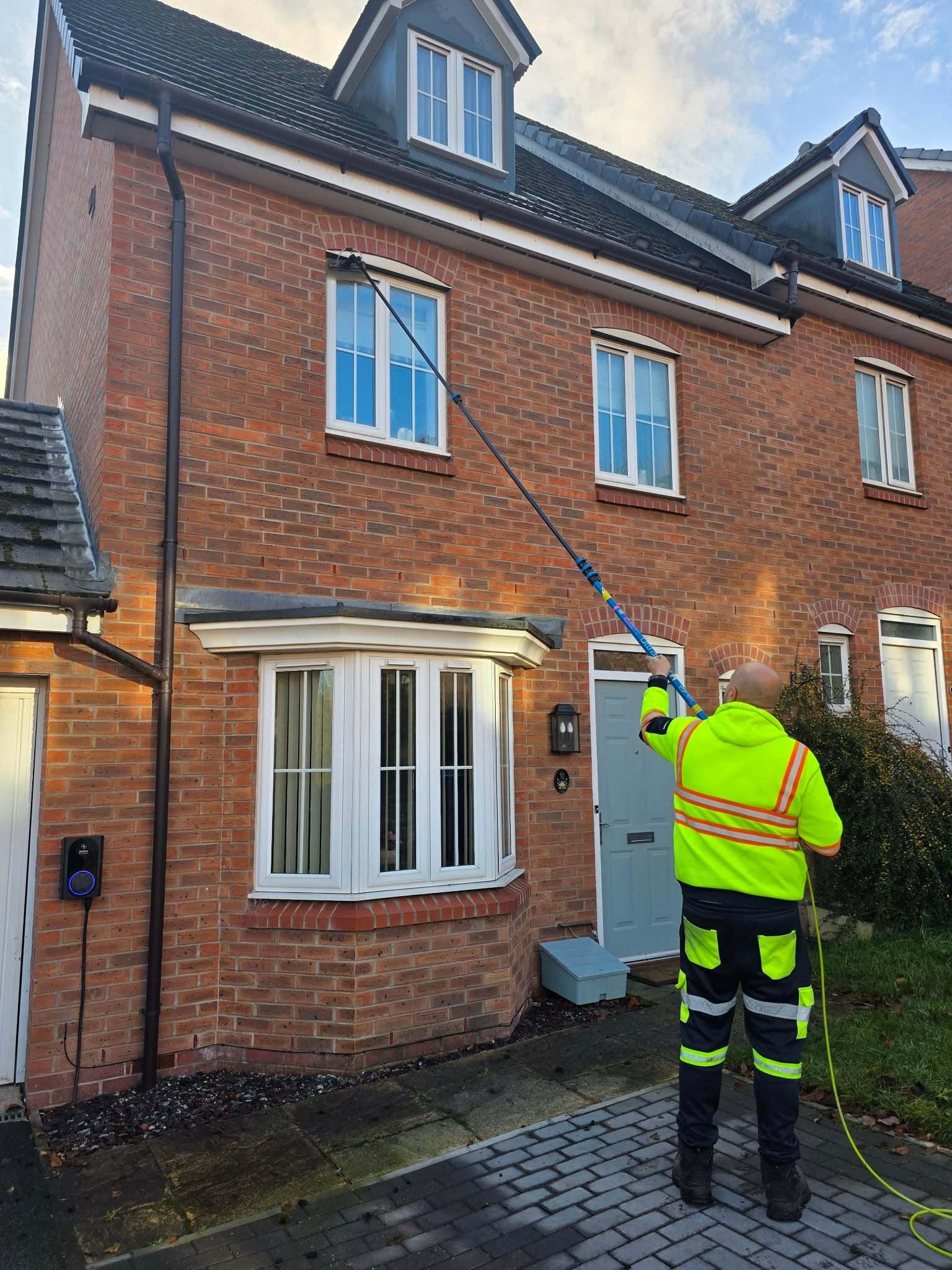
Can roof windows and skylights be cleaned with a water-fed pole?
Yes, where the exterior glass can be reached and the brush can be controlled from a safe ground position. A water-fed pole can deliver purified water to sloping or elevated glass without the cleaner or homeowner walking on the roof.
However, reach is three-dimensional. A roof window may be only one storey above the ground but set far back on a deep roof slope. Another may be lower but hidden behind a conservatory, extension, gutter, parapet or fragile roof section. The horizontal distance and working angle can matter as much as the vertical height.
A responsible assessment therefore asks:
- Can the cleaner stand on firm, suitable ground?
- Can the complete pane be seen well enough to brush and rinse?
- Can the pole be raised and moved without overhead obstructions?
- Does the brush reach the glass at a controllable angle?
- Is there a safe hose route to the working position?
- Could the pole or brush contact tiles, flashing, gutters, cables or delicate components?
If the answer to any of these questions is unclear, photographs or an on-site assessment are more useful than a promise based only on the window’s height.
Roof window, skylight, rooflight or lantern: why the type matters
Homeowners often use these terms interchangeably, but the layout can change the cleaning approach.
| Glazing type | Typical position | Main access consideration |
|---|---|---|
| Sloping roof window | Installed within a pitched roof | Distance up the slope and brush angle |
| Flat-roof rooflight | Horizontal or slightly pitched on an extension | Visibility, setback from the edge and standing position |
| Roof lantern | Raised glazed structure on a flat roof | Multiple angled panes, height and surrounding roof area |
| Dormer window | Vertical glazing projecting from a roof | Whether a clear line is available from the ground |
| Window above a conservatory | Vertical pane beyond a glazed roof | Distance, pole leverage and fragile surfaces below |
The service discussed here is residential exterior glass-focused window cleaning. It should not be confused with cleaning the entire roof, roof coverings, gutters, flashing or the full exterior structure of a lantern.
How pure-water cleaning works on sloping glass
The water-fed-pole brush provides agitation to loosen routine exterior dirt. Ultra-pure, extremely low-TDS water then rinses released contamination from the glass. The pane is normally left wet to dry naturally.
Sloping glass changes how water moves. The rinse may travel quickly down a steep pane or collect differently around a shallow pitch, seals and frame edges. The cleaner needs sufficient water flow and a controlled brush position to cover and rinse the accessible exterior glass properly.
Pure water is not a substitute for technique. Results still depend on:
- water quality;
- adequate brushing;
- enough flow and rinsing;
- the condition and behaviour of the glass;
- safe, stable pole control;
- being able to see the area being cleaned.
Window Cleaning Telford prepares its own purified water before the visit and brings the required supply to the property. The customer’s household water supply or outside tap is not used.
For the general process, read how pure-water window cleaning works.
What makes a roof window easier to reach?
- A clear, firm working area at ground level.
- A visible pane close to the lower part of the roof slope.
- No conservatory, deep extension or fragile structure beneath it.
- Space to raise and angle the pole.
- No low cables, branches or other overhead obstructions.
- A manageable horizontal distance from the cleaner to the glass.
- A frame and surrounding area in sound condition.
- A safe hose route that does not create unnecessary hazards.
None of these factors guarantees access on its own. Together, they help the cleaner judge whether a ground-based water-fed pole is suitable.
What can make a skylight difficult or unsafe?
A deep setback on the roof
A pole may have enough length to reach the height but still be difficult to control when the pane sits far back from the building edge. The greater the horizontal reach, the more leverage the cleaner has to manage.
A conservatory or extension below
Fragile roofing beneath the working area limits where the cleaner can stand and how the pole can be positioned. The pole should not be forced across glass or roof panels simply because the target window is visible.
The separate guide to windows above conservatories and extensions explains this access problem in more detail.
Poor visibility
If the cleaner cannot see the brush, edges of the glass and rinse path, it becomes harder to assess coverage and avoid surrounding components. Reflections, roof design and the viewing angle can all restrict visibility.
Strong or gusting wind
Wind can make a long pole harder to control, particularly when it is extended at an angle. Light rain is not automatically a reason to cancel, but severe wind or another genuine hazard can require postponement.
Slippery or uneven ground
The cleaner still needs stable footing even though the work is being carried out from ground level. Ice, steep slopes, loose surfaces or waterlogged ground can make the position unsafe.
Delicate glass, films or coatings
Known window film, tinting, special coatings or damaged glazing should be disclosed before the visit. Cleaning should not begin on the assumption that every roof window has the same surface.
Damaged seals, flashing or frames
Water from exterior cleaning can expose existing gaps or leaks. Tell the cleaner about known problems rather than using the clean as an unplanned leak test.
If water has previously entered during exterior cleaning, see why water can come inside through windows.
Why a ladder is not automatically the answer
When a roof window cannot be reached with a water-fed pole, it does not follow that somebody should simply place a ladder against the building or walk on the roof.
There is no universally best access method. The right decision depends on the height, duration, site conditions, equipment, fragile surfaces and the nature of the task. For a routine residential clean, postponing or excluding an unsafe pane can be more responsible than forcing an unsuitable method.
Homeowners should not climb onto extensions, conservatories or pitched roofs to prepare the glass. A photograph taken safely from inside and a wider ground-level exterior image are normally far more useful.
What photographs should you send before booking?
A close-up of the glass alone rarely shows whether the cleaner can reach it. Send photographs that explain the whole layout.
- Interior location photo: show which roof window is involved without leaning out.
- Wide exterior photo: include the ground, wall, roofline and complete window position.
- Side-angle photo: show how far the pane sits back on the roof slope.
- Obstacle photo: include conservatories, extensions, sheds, fences, cables or trees below.
- Access photo: show gates, passages and the likely working area.
If more than one roof window is involved, label the images or describe the front, rear or side elevation. Mention whether the photographs were taken with vehicles or movable obstacles in their normal positions.
What contamination can be removed?
Routine exterior dirt, dust, pollen and ordinary weathering may respond well to proper brushing and pure-water rinsing. Roof windows can collect more visible material because of their angle and exposure, including airborne dirt, bird mess and runoff from nearby surfaces.
Not every mark is ordinary dirt. Paint, mortar, render, silicone, adhesive, severe mineral deposits, scratches and etched glass may remain after routine cleaning. The location of the pane can also make specialist removal impractical or unsafe.
Disclose recent roofing, building, decorating or installation work before booking. Do not scrape a roof window from inside while leaning through the opening.
Related guidance:
- can professional cleaning remove bird droppings?
- window cleaning after building work
- are window marks inside, outside or between panes?
What should homeowners do before the visit?
- Close the roof window fully and check that it has latched.
- Close suitable vents if the manufacturer’s arrangement allows it.
- Report known leaks, damaged seals or cracked glass.
- Remove only easily movable items that block the agreed ground position.
- Arrange access through locked gates.
- Keep children and pets away from the hose and working area.
- Move a vehicle only if it genuinely blocks the safe position and this has been agreed.
- Tell the cleaner about films, coatings, leaded details or unusual glazing.
- Provide wide photographs before arrival.
You do not need to climb onto the roof, pre-clean the pane, remove the roof window or move every object in the garden.
The full pre-window-cleaning checklist covers access, gates, paths, pets and hoses.
First clean versus regular maintenance
A roof window that has not been cleaned for a long time may need more brushing and rinsing than one maintained on a regular schedule. Dirt can build up near the lower frame edge, seals and areas where water naturally drains.
A first clean may therefore take more work, but Window Cleaning Telford does not apply an automatic first-clean surcharge. The glass condition and safe access still need to be understood rather than assumed.
Regular six-weekly cleaning can make the condition more predictable, but exposure varies. A roof window beneath trees or near a bird-perching point may change faster than a sheltered vertical pane.
Weather considerations for roof windows
Light rain does not automatically prevent pure-water cleaning. Wind is often more important for an extended pole because it affects control and accuracy.
Dangerous ice, severe wind, lightning, unsafe access or another genuine site hazard can require postponement. In winter, heated purified water is used and the entire water-fed-pole system is heated, so cold weather alone does not stop normal work.
Read whether window cleaners work in the rain and the cold-weather window-cleaning guide.
Questions to ask before booking
- Can you assess this roof window from photographs?
- Is the complete exterior pane likely to be reachable from safe ground?
- Does the conservatory, extension or roof setback restrict access?
- Is the request for exterior glass only?
- Should any gate or side passage be opened?
- Does somebody need to be home?
- What contamination should be disclosed beforehand?
- What are the price and payment arrangements?
A clear “this pane may not be safely reachable” is more useful than an unconditional promise made without seeing the property layout.
Frequently asked questions
Can every skylight be cleaned from the ground?
No. Some can be reached with a water-fed pole, but roof pitch, height, setback, visibility, obstructions and safe pole control all matter.
Can you stand on my extension roof to reach it?
Do not assume that a roof or extension is a suitable working platform. The aim of the water-fed-pole method is to work from a safe ground position where appropriate. Unsafe access should not be forced.
Will pure water remove bird mess from a roof window?
It may remove routine bird contamination with suitable brushing and rinsing, but the condition, age of the deposit and safe access affect what is practical. No universal result should be guaranteed without assessment.
Should the roof window be open or closed?
Closed and properly latched. Exterior cleaning sends water across the outside of the pane and frame, so an open window can allow water indoors.
Will the glass be dried by hand?
No. Pure-water exterior glass is normally rinsed and left wet to dry naturally. Drying time varies with temperature, airflow, shade and humidity.
Do you need to use my outside tap?
No. Window Cleaning Telford prepares and brings its own ultra-pure, extremely low-TDS water. The household water supply and garden tap are not used.
Can a roof lantern be included?
Possibly, where the agreed exterior glass can be safely reached and controlled from a suitable ground position. A wide photograph is needed because lantern height, angle and setback vary considerably.
Ask about roof-window cleaning in Telford
Window Cleaning Telford provides residential exterior glass cleaning using a Pure-Water Water-Fed Pole system. Regular six-weekly and one-off cleaning are available. The minimum call-out is £19, and there is no automatic first-clean surcharge.
For a roof window, skylight or rooflight enquiry, use the contact page or telephone enquiry option. Send a close photograph of the pane and a wide exterior photograph showing the ground, roofline, obstacles and access.
You can also review the confirmed information on the prices page and the main Window Cleaning Telford service page.